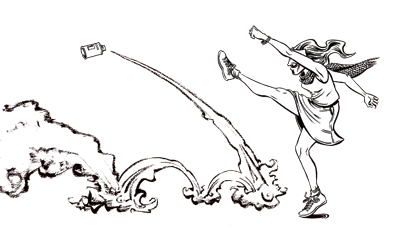


6.) Widow Kang

I’ve set myself a February goal of illustrating every chapter of Kim Stanley Robinson’s alternate-history novel, The Years of Rice and Salt, and so far it’s been really exciting! I feel as though I learn three or four new things with each drawing, and each is (to me) better than the previous. The only downside is that it’s making me slack off on my main project, Savage Nobles in the Land of Enchantment. For some reason I do not put as much effort into my comics pages as I do into these illustrations – maybe it’s because of the demanding 2 1/2-page-a-week schedule of SNitLoE, or because I’ve been drawing those same characters off and on for two whole years. Don’t get me wrong, I definitely plan to finish the story. But my “side projects” are opening new and fascinating possibilities for my future!
So even though this illustration is pretty exciting, “Widow Kang” is definitely the book’s most boring chapter. Most of it is about the feisty titular widow and her second marriage to a Chinese Muslim scholar, Ibrahim Ibn Hasan. Ibrahim is a sort of alternate-history Hegel who undertakes the possibly impossible task of synthesizing Islam and Confucianism, but stumbles upon some clever ideas along the way. He sees the philosophical synthesis as indispensable, for huge populations of Muslims continue to move into western China’s Gansu corridor, where this chapter takes place, and skirmishes and rebellions are frequent.
Since most of the chapter is about two middle aged people sitting on their porch and debating ideas, it makes for interesting reading, but not much worth drawing. Until there is a huge flood! Poor Kang has to evacuate her house and try to save her writings in a state of advanced pregnancy and with legs crippled long ago by footbinding. (And in the story, her husband was not there to help her – I just added him to the illustration for the heck of it.) I did some google searches for images of footbinding… just, ew.
Read MoreHopi Hairstyles
Hopi women have such awesome hairstyles! Last winter in New Orleans I picked up a used coffee table book about the contemporary Hopi reservations in northeastern Arizona to use as visual reference. In addition to architectural, fashion and phenotypic information, I was particularly concerned with finding a “look” for Theo’s friend Manaka. I wasn’t even to the table of contents of Hopi by Susanne and Jake Page when I met this beauty staring right back at me:

She’s too young for Manaka’s character, but the look is there, if I could only capture it. I had seen similar, and even more elaborate, hairstyles in historical photographs of Hopi women:

As cool as these swirly braids look, I have a hell of a time trying to draw them from different angles. Expect a considerable amount of “Mickey Mouse ear syndrome” as Manaka’s hair migrates over the surface of her head.

5.) Warp and Weft

Here’s my illustration from chapter five of Kim Stanley Robinson’s The Years of Rice and Salt, an alternate history novel that imagines how history might have developed if the plague had wiped out 99% of the European population instead of 30-60%.
Chapter five, “Warp and Weft” (a basket-weaving term), is told from the point of view of Hodenosaunee Indians in what we would call the Hudson River valley, in what we would call the early 18th century. The story centers around a mysterious stranger “Fromwest.” Fromwest is actually a ronin (masterless samurai) who fled to the New World from Japan, which has been completely conquered by the Chinese. Determined to preserve the “unspoilt” natives from a similar fate, at the hands of China or the European Muslims (who are simultaneously colonizing the New World from the east), Fromwest tries to convince the Hodenosaunee 0f the importance of industrialization and firearms manufacture to their survival. However, he urges that, while industrializing, the tribe must not abandon their complex but functional system of consensus-based, psuedo-matriarchal government, which is the best form of government he has ever seen. Through such a system, a massive alliance of all New World tribes against the colonizers is an actual possibility.
Robinson is not so naively PC as to suggest that the “American” natives were always fully capable of defending themselves, but neither is he so condescending as to intimate that they could only be defended by an altruistic outsider (what we might call the “Avatar” approach.) Instead, he invents a properly radical-historical narrative, where the “best” of the oppressive outsider (in this case, industry and empirical science) is adopted by the colonized and turned against them. KSR’s dialectical ideas really start to emerge in this chapter, and are further solidified in the next chapter, “Widow Kang.” I think he’s right to point out that often the most productive areas of society are not the central monoliths, but the interces, the points where two cultures intersect on the periphery of either.
I’m still trying to get a handle on this ink-wash thing, trying to keep in mind the principles of atmospheric perspective, with pretty limited success. I feel that if I can learn how to craft pleasing compositions in grays, my black and white illustrations will improve and I might even learn something about color.
Up until the very last minute, I had planned to show Fromwest and the Indian practicing katana stances from a medium close-up point of view, and I’d even done some fairly detailed figure studies based on actual katana positions. But I’m trying to keep myself from falling into a comfortable 2/5 rut, where all my compositions are based on dividing the page into fifths and placing the center of attention two fifths from the left or from the right. That approach is like the minor pentatonic scale – just because it always sounds good, that’s no excuse not to try something else. I woke up yesterday and decided to go for the wide shot, to show tiny figures against the expanse of the American wilderness. My hero James Gurney would be so aghast to see how inconsiderately I’ve treated the Hudson River valley, the site and subject of so much incredible plein air painting.
Read More4.) The Alchemist

Click to read my explanation of what’s happening here.
Here’s my illustration for chapter four of The Years of Rice and Salt by Kim Stanley Robinson. “The Alchemist” tells the tale of Khalid, a Samarqandi armorer whose right hand is chopped off by the Khan when his demonstration of transmuting lead into gold is discovered to be fraudulent. He is rescued from spiraling depression by his son-in-law, the Sufi-minded Bahram (center), and Iwang(right), a mathematically-minded polyglot. They gradually launch an Islamic Renaissance in Samarqand (in the Muslim 1050’s, our 1640s), eschewing the conjectures of the Ancients and constructing a method of empiricism that quickly leads to many discoveries in diverse fields, theoretical and practical. (Of course the Khan is only interested in weapons).
In the scene I’ve depicted, the three of them are walking home one night after a vailiant but failed attempt to measure the speed of light, slightly drunk. When Bahram asserts that the purpose of life is to “make more love,” Khalid (whose scribbly notebooks designate him as a sort of alternate-history Leonardo Da Vinci, with a touch of the martyred Galileo) concedes but adds that it is our duty to Allah to understand His world, in order to love it. Iwang, meanwhile, envisions a mathematics that would measure “the speed-of-the-speed.”
It’s a great chapter, where KSR’s strength for writing that is intellectually stimulating, and not just a relentless emotional roller-coaster, really shines. Sure, there are some beautiful moments of character development, but the most engaging passages are where we witness an old discovery or invention (vacuum pumps, barometers, the telescope, calculus, even nasty things like mustard gas) being made again in a novel way. It reminds me of middle school, when science was in my hands, not in the hands of distant, corporate-funded lab technicians; when science was fun. It’s a chapter I think my scientific-atheist friends could really appreciate, despite the heavy Muslim/Buddhist overtones.
Kuleshov Komics
The Kuleshov Effect is a phenomenon in cinema whereby audiences perceive facial expressions differently depending on context. In the 1910’s and 20’s, Russian filmmaker Lev Kuleshov designed an experiment that involved a sort of movie collage: A shot of a bowl of soup, followed by the impassive face of handsome actor Ivan Mozzhukin reacting to it; then a shot of a little child in a coffin, followed by Mozzhukin’s face again; finally a shot of a beautiful and seductively dressed woman, and Mozzhukin’s reaction. Audiences praised Mozzhukin’s brilliantly subtle acting, his nuanced expression of hunger, restrained grief, and boiling lust. But as you probably have predicted already, each reaction shot was exactly the same – the same footage every time.
Alfred Hitchcock explains the same phenomenon in this video:

HOW DOES THIS APPLY TO COMICS?
On the one hand, comics artists, and cartoonists in particular, have an obsession with, almost a fetishization of, facial expressions. From the simplest distillation of an emotion into a few carefully-chosen lines, to an elaborately rendered portrait of a distinct countenance, we all seem to strive for the most evocative faces possible. Some people have actually insisted this is the single most important storytelling mechanism for a comics artist, more important even than body language. The ridiculously great facial-expression guide by Lackadaisy artist and comics samurai Tracy Butler has been making the rounds on the internet, and deservedly so. She’s got the art of drawing facial expressions down to a science (or maybe the science down to an art – I’m not sure.)

But on the other hand, comics are not single images like a painting, but an arranged series, like a movie. Because we tell our stories through sequential juxtaposition, *ahem, puts on green plaid shirt and opaque full-moon glasses*, why exactly do we need the perfect, nuanced facial expression every time, when, at least according to the theory of the Kuleshov effect, a perfectly neutral face will do? An incredible amount of emotion can be imparted into a blank face given the context that comics can provide. Sarah Oleksyk took this to its sublime extreme in one of my favorite single comics panels of all time, from book five of her series Ivy:

Here, perhaps the biggest emotional turning point of the entire series is represented a 3/4-rear shot. What is Ivy thinking? Oleksyk doesn’t say. She only asks what YOU think she’s thinking.
Two years ago, when I started this comic you’re reading now, I had not heard the term “Kuleshov Effect,” but I knew I was interested in the comics possibilities of blank, ambiguous facial expressions, and I used them a lot. This was particularly useful since I was still learning how to draw.

I’ve come a long way in my artistic abilities since then, and I like to think I’m capable of much more convincing, expressive faces that are interesting in themselves. But sometimes I worry that I’ve thrown out baby Kuleshov with the bathwater. I try to remember that sometimes, rather than telegraphing emotion so obviously, the right thing to do is to let the reader fill in their own subtext.