

The Education of Hopi, Class
The native American pueblo into which Theo has been welcomed (?) is fictional, but I modeled it after the villages of the Hopi. The Hopi are from northeastern Arizona, so placing a similar tribe in southern New Mexico is a bit of a stretch, but I have been so fascinated by the Hopi since I first read about them in a middle school American history textbook that I couldn’t pass up the opportunity to include them in my desert epic. Their art and culture, the songs and dances of their religion, their groovy adobe villages that spring out from the mesas like mushrooms from a tree stump – it’s all extremely cool… you know, when you get past the miserable tragedy. And even if it would remain untranslated, I really wanted to include some snippets of the Hopi language.
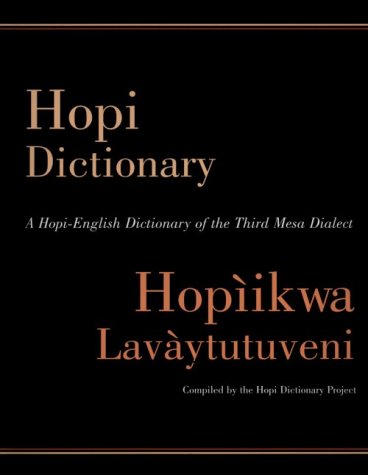
I was reading reviews online for the Hopi Dictionary/Hopiikwa Lavaytutuveni, which apparently is one of the best translation-dictionaries of any language in the entire linguistics community. I knew I’d never be able to afford this sucker, but to my delight there was a copy at the central Multnomah County Library.
It is indeed an exhaustive tome. But since it’s only a dictionary and not a book of grammar, I had no way of constructing the sentences I wanted to place in the mouths of my characters. My compromise was to look up individual words that might possibly relate to my desired dialogue, and see if the example sentence could conceivably work. I was expecting “Where is Maria? Maria is in the library.” What I got were complex and interesting sentences which proved surprisingly appropriate to my story. Here are the dictionary example sentences used in my comic, which the elder uses to shoo Theo away on page 96:
“Yupáy, yamáku’u. Nu’ pay son pew Pahanmuy tangatani” – Go on, get out. I’m not going to admit Anglos here.
And which the Indians murmur while gathered around the Theo as he eats on page 97:
“Velakaana? Kastiilam?” – An American? A Mexican? (The Hopi word for “Mexican” is the same as the word for “Spaniard,” and you can see that it’s derived from the word “Castilian.”)
“Pam so’oosouik qömuit akw tsoqa’asi’y tangwu.” – He is painted all over with black body paint. (no, those are tattoos!)
“Pas pam himu son suup haqam nakwhani’y tangwu.” – He’s one who just can’t seem to stay in any one place. (This could be Theo’s entire biography. Or Tonya’s!)
“Puma pas qu atsat lalakharum.” – He is excessively skinny. (fair enough)
“Um okiw hin ewayhoya.” – You poor, ugly little thing. (Hey!)
So hopefully from these few rudimentary snippets, you can see there’s a lot more to this language than the “Koyaanisqatsi” of Phillip Glass’s film score.

Theo’s Tattoos: Ladder of Divine Ascent

I feel bad that I didn’t design this tattoo to be placed in a more prominent location. Unfortunately, at the time I was designing my characters, it had not yet occurred to me that human beings are three dimensional and have sides as well as fronts and backs (okay, that’s an exaggeration, but not much of one). So when I finally placed the tattoo of the Ladder of Divine Ascent, it was divinely ascending into Theo’s left armpit.

The Eastern Orthodox icon is based on the instructional writings of St. John Climacus (7th century AD) and the visual imagery of “Jacob’s Ladder,” a dream which Jacob had in Genesis 28 about a ladder stretching from earth to heaven. I first became familiar with the image from the tattered cover of my parents’ copy of The Great Divorce, a novella by C.S. Lewis.
Cowboys & Aliens?
Readers have drawn my attention to the recently released trailer for “Cowboys & Aliens.”
This movie looks seriously awesome, but I’m not worried about similarities with the comic you’re currently reading. I promise that page 89 is the closest you’ll ever come in this comic to seeing what might be a cowboy fighting what might be an alien.

SNitLoE Car Trouble
Here’s a pinup I did for my friend Turhan Sarwar when he won contest I was having over at Savage Nobles in the Land of Enchantment. After I sent him this black and white image:

I decided to color it, with the following result:

Even though I’m generally pretty pleased with how it came out, I still suffer from that oh-so-common cartoonist regret: that the finished drawing never achieves the wonderful, spontaneous dynamism of the original 2″x3″ pencil-scrawled thumnail:

(when I am thumnailing pages for the main comic, I routinely indicate the character Kafir with nothing but two angry rectangles (his glasses) and a black oval (his perpetually yelling mouth.) Jeff Smith said he designed “Phoney Bone” as a child to be a character with a telephone receiver for a head so that it always looked like he was yelling – which was appropriate, because in Bone, Phoney always is yelling. I think I might have pulled a Jeff Smith.)
Read MoreReligious "Auto-Bio" Comic
The theme for December’s issue of Stumptown Underground is “Religion & Spirituality.” Though I have spilled a fair amount of ink in my graphic novel so far regarding these topics (and will spill even more before it’s done), a lot of SNitLoE’s religious material is theoretical commentary told through allegorical characters. But for this little comic, I decided to do something unusual (for me) and write more in the Stumptown spirit of revelatory auto-bio. And if other zinesters and comic artists can write so frankly about their intimate experiences with family, sex, food, having sex with food, eating their families, etc., then I can certainly tell a little story about my own faith.


Hopefully that speaks for itself, but I feel I should add one thing: This comic is very unfair to St. Teresa of Avila, who was definitely experienced in painful doubt and “the long dark night of the soul” (an expression, incidentally, which comes from the title of a poem by another 16th-century Spaniard, St. John of the Cross.) Really, the whole “the past = faith; modernity = doubt” shtick is incredibly disingenuous on my part, as I know very well it’s not that simple at all. As usual, I think it’s Slavoj Zizek who sums it best in this short video:
I quoted Mother Teresa’s anxious letter, but I might just as well have quoted the earlier Teresa, who wrote:
“As to the aridity you are suffering from, it seems to me our Lord is treating you like someone He considers strong: He wants to test you and see if you love Him as much at times of aridity as when He sends you consolations. I think this is a very great favor for God to show you.”
Again with the aridity! The desert metaphors come fast and furious.