

Theo’s Tattoos: Four-letter Word
Now and then I will post short entries about Theo’s tattoos – not the scholarly treatment they deserve, just a little background information. Because the tattoos have to be roughly the same every time I draw them, and on roughly the same part of the body, I had to plan them out fairly carefully – though if it had occurred to me at the outset how many times I’d have to draw them, I would have planned them even more carefully. My friend Ben Bates, who draws Sonic the Hedgehog for Archie comics (among with many other things) and who has one of the keenest minds for character design I’ve ever come across, says that having a character covered in tattoos who spends most of the comic shirtless is already in itself a horrible idea. I totally agree, but unfortunately for me and my right hand, it’s also crucial to the plot.

On the underside of Theo’s left forearm is the instantly recognizable Tetragrammaton. No, that’s not some kind of giant Japanese robo-warrior, it’s the Hebrew four-letter name for God. Because this word is all consonants, with the vowels varying or implicit, there’s a lot of confusion as to how it ought to be pronounced. But this isn’t actually a problem, since to Jews “The Name” is actually too sacred to be pronounced, except perhaps by one person in one particular place, once, on one particular day of the year… and even that, not so much lately. Needless to say, getting this tattooed on your arm is probably pretty risque, if not downright offensive, since Judaism does not generally allow tattoos of any sort in the first place.
It’s possible, however, that Theo got the tattoo when he was a Christian. After all, the Christians use many of the same texts – whenever you see the phrase “the LORD” in all capitals in an English-language bible, it often holds the place of the tetragrammaton (although the frequent Hebrew euphemism “Adonai” is also translated as “Lord”). This brings me to an Interesting Personal Anecdote:
I’m thrilled to be singing in the 13th Annual William Byrd Festival with the early music choir Cantores in Ecclesia. At one service we will be chanting Psalm 68, which contains the line “magnify him that rideth upon the heavens as it were upon an horse; praise him in his Name, JAH, and rejoice before him.” Here, “Jah” is a shortened, two-letter version of the Name (incidentally, a root of the word “Hallelujah,” and name of God used by Rastafarians). This is the only instance of the name “Jah” in the entire King James Bible. For some unfathomable reason, it was translated as “JAH” just this one time. Unsurprisingly, we singers are baffled as to how to pronounce it.

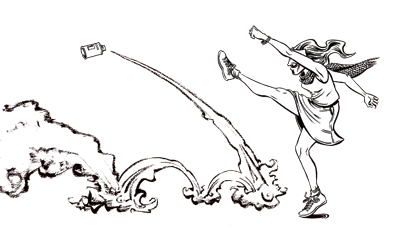
Surprise!

This is my submission for Stumptown Undeground‘s birthday-themed first anniversary issue. Even if it doesn’t get accepted (I wouldn’t blame them), I’m going to include it in a planned zine anthology I’ll be putting together for the Portland Zine Symposium. Together with my story Laundryman, the illustrated poem Cockaygne, and maybe some new original stuff, I think I’ve got a nice 12-pager about being yanked out of a fantasy comfort zone into dingy, corporeal reality.
Read MoreOn Smarty-Pants Stories
While my friend Dylan Meconis is at San Diego Comic-Con, I am taking care of her cats and dog. The first printed volume of Dylan’s excellent webcomic Family Man just came out, and I’ve gotta say, it works much better as a tactile book than a website. (Though the Family Man website, with it’s flaking pages and trompe l’oeil accessories is probably as close to being tactile as anything on the internet. She gave me great WordPress advice for this site, and maybe some day I will implement more of it.)

I could write a whole list of reasons why Family Man is such a good comic (through-composed, novelistic scope; amazingly rigorous historical research; costume porn), but one reason stands out for me personally: it is an honest treatment of Characters Who Are Intellectuals. This is actually something I care a lot about. There are way, waaay too many stories out there about college professors, architects, classical composers, writers (oh, writers!), world-renowned anthropologists/violinists etc. etc. where the main thrust of the entire narrative seems to taunt “See? See? Beneath all his pretensions of intellectual superiority, he is just a regular shmoe like anyone else! In fact worse! He cheats on his wife and sleeps with his students and gets drunk and wakes up in the morning and looks at his own haggard, stubbly face in the metaphorical bathroom mirror!”
As much fun as it might be to take this strawman out of the attic for a good whacking session now and then, it’s a tremendous missed opportunity. Intellectuals, as a class, have pretty unique and interesting internal lives of a specific sort not necessarily found in the middle- or working- class hero. When the protagonist is a scholar, when he lives in the realm of ideas, the writer has the chance to create a true novel of ideas, a work in which the characters and plot can serve as a playground (or battleground) for abstract theories or beliefs in a particularly raw, even allegorical, way. At the end of a great story-about-intellectuals, such as the movie Pi or the book Elizabeth Costello, we find ourselves worried less about what will actually happen to the character (will Max Cohen be captured by the Wall St. goons or the radical Hassids? will Elizabeth live long enough to reconcile with her family?) than by what direction their thoughts take (can Max’s capacious brain discern an underlying order to the universe? can Elizabeth’s atheism coexist with her belief in the positive existence of Evil?) Back to Family Man: though I’m somewhat interested to see which characters turn out to be werewolves, I’m on the edge of my seat waiting to see if Luther Levy fully accepts atheism or regains his religion.
And this doesn’t necessarily have to be deadly serious. Without belaboring the topic too much longer, this relates to what I tried to do with “Apostrophobia,” my regular funny cartoon in the Columbia Spectator. Tired of the “college humor” whose basic joke was that, for all our academic pretensions, college students are basically lazy, indulgent, sex-crazed, alcoholic morons (the “VanWilder” school of comedy), I tried to invert the joke and show that the most hilarious thing about Columbia students was our very commitment to academia, that we voluntarily withdrew from contemporary society at large – and in many cases, from the contingent realm itself – to immerse ourselves in a universe of total abstraction. Engineers excepted.

I recently found a passage where Slavoj Žižek stole my idea and expressed better:
“[I]t is true that the space of the comic is the space between the dignified symbolic mask and the ridiculous vulgarity of ordinary life, with its petty passions and weaknesses; the properly comic procedure, however, is not simply to undermine the dignified mask (or task or sublime passion) through the intrusion of everyday reality, but enact a kind of structural short circuit or, rather, exchange of places between the two in which the very dignified mask/task/passion appears as a pathetic idiosyncrasy, an utterly human weakness.”
By the way, with all this high-fallutin’ talk, I hope you still do care what happens to Kafir. By now it’s been revealed that the “government guys” who rented all the other rooms in the motel are in fact ICE police, and they’ve got Kafir’s personal hero, Ernesto Alvarez himself! Hopefully you caught the mentions of Ernesto on page 5, page 19, and/or page 27 so that his appearance isn’t completely out of the blue.
Frank Reade, Jr.
This blog post is long because it’s about something I’ve been doing for a long time.

Though I complained about a lack of income in a previous post, the truth is I’ve been kept afloat because of the editorial work given to me by Paul Guinan. Paul and his wife Anina Bennett are working on the companion piece to their hit fake-history-coffee-table-book, Boilerplate. The new book will focus on the dime-novel character Frank Reade, Jr.
From what Paul has told me, this guy was all the rage in his time, basically the 1870’s version of Superman. Is it proto-scifi or the last gasp of classic adventure fantasy? Thomas Edison fan-fiction or the original steam-punk? Harmless escapism for teenage boys, or an Anglo-sadistic fantasy of racist-imperialist propoganda? The answer, of course, is all of the above.
I’ve now skimmed through all 191 issues of “the Frank Reade Library,” summarized them all, categorized them by the type of invented vehicle (usually an electric submarine, airship, or all-terrain land vehicle, but sometimes something preposterous like a steam-powered horse), by quest (it’s always buried/sunken treasure, tracking down a bandit/pirate, rescuing a maiden, finding evidence that will exonerate somebody on death row, or viewing a meteor that can only be seen from one spot on the globe), location (the earlier stories were all in the wild west, but they moved on to Africa, India, China, Russia, Peru, the Arctic – basically wherever there are minorities to blow up… and in the world of Frank Reade, “Spanish” counts as a minority) and by the presence of strong female characters (zero, none, absolutely none, or, occasionally, one). The stories somehow managed to be both incredibly imaginative and diverse while still mind-squashingly formulaic. I can safely say they are everything, but well-written.
Paul is a sensitive guy who knows how to deal with sensitive issues, and I think he and Anina are planning to give Frank a serious 21st-century face-lift. I suspect Frank’s two sidekicks, the dixie imbecile/expert electrical engineer Pomp (called “a negro” if you’re lucky, much worse things if you’re not, and who says things like ‘Massa Lawdy, what am dis chile gwonna do?’) and the comical Barney O’Shea (apparently 1870’s Americans thought being Irish was endearingly hilarious – Barney’s impassioned tirades against British oppression are played alternately for laffs and sympathy) will be transformed into Denzel Washington and Brad Pitt respectively. I’m sure his world-policing expeditions will be morphed into humanitarian diplomacy. I’m still not sure if they should be.
I was a history major, and I’m still fascinated by history. Lord knows that even though my area of study (the Middle Ages) was a millenia-long parade of horrors, I still idealize and even romanticize it. But as a leftist, I cannot help but view the late-19th-century Atlantic world with burning contempt. Truly, when I read about the deeds of the industrialist or imperialist elite of the 1870’s, it makes my blood boil. And in the Frank Reade stories, these are the very people the hero comes to rescue! Half the stories are about rescuing millionaires or millionaire’s beautiful daughters from the ebony clutches of colonized forces.
In the Philolexian Society, we often liked to pretend it was the 19th-century. I did it too, because it’s fun. The inscrutable “steam-punks” have built up an entire lifestyle around how fun it is. But I always feel like I’m dining with the devil. The late 1800s is a period we should remember, which we can respect or even playfully recreate. But it’s not a period I want to identify with. Frank Reade, Jr. may have been the vicarious idol of thousands of boys, but there’s almost nobody in fiction I’d rather not be.
All that said, lookin’ forward to the new book… and even more for _____________ (Paul told me what I had written here before is a secret – if you read this blog on Thursday, July 15, please don’t mention what I accidentally said!)
edit: okay, it’s okay to disclose now! JJ Abrams is producing the Boilerplate Movie! Whoohoo! You didn’t hear it here first.
Read MoreBarnaby a.k.a. Fatty

I mentioned that my house has two cats. The younger one, a kitten named Javier, will never sit still long enough for a portrait. The older one, Barnaby, definitely will.
Read More