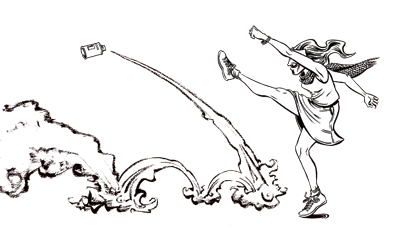


3.) Ocean Continents

Here’s my illustration for chapter three of The Years of Rice and Salt, in which the Chinese discover the New World. An expedition in the Christian 1620s to conquer a small Japanese port goes astray and is dragged by a current all the way across the Pacific. The survivors eventually dock in what we would call the San Francisco Bay. The relationship between Admiral Kheim and his crew, and Butterfly, a small Miwok girl they adopt to use as a translator, is in my opinion the most touching in the book. Oh, and though Kheim and the Chinese marvel at the unspoiled simplicity of the Miwok, suffice it to say a journey much further south convinces them that not all savages are noble.
Great quote for those of you who’ve read it (context-sensitive, spoiler alert):
Kheim said to [the emperor], “That far country is lost in time, its streets paved with gold, its palaces roofed with gold. You could conquer it in a month, and rule over all its immensity, and bring back all the treasure that it has, endless forest and furs, turquoise and gold, more gold than there is yet now in the world; and yet still the greatest treasure in that land is already lost.”
Read More2.) The Haj in the Heart

Here’s my illustration for chapter two of Kim Stanley Robinson’s alternate history novel The Years of Rice and Salt, entitled “The Haj in the Heart.” Most of this chapter is set in the 970’s (the Christian 1590’s) and follows Bistami, a Sufi Muslim from Gujarat, India who is saved from marauding thugs by a friendly tiger and later becomes a personal religious adviser to the Mughal Emperor Akbar (another real historical figure). After he falls out of favor with the emperor and his bureaucracy, he is sent on the Haj to Mecca, and proceeds from thence west (chapter two is basically a geographical mirror image of the east-bound chapter one) across northern Africa. Eventually he crosses the straight of Gibraltar to Spain, where an intrepid group of Muslim pioneers have been gradually recolonizing the abandoned European continent and attempting to recreate the golden age of al-Andalus. It is here that Bistami sits in an orange grove with Ibn Ezra, a sort of proto-proto-scientist, in the scene I have chosen to depict.
A debate arises over why the plague happened. An orchard-keeper proposes the common explanation, that Allah killed the Christians because of their wicked and polytheistic ways. Ibn Ezra differs, noting that many Christians in Ethiopia and elsewhere survived, and moreover that the plague killed many Muslims in the Balkans and southern Spain. Instead, he offers a biological explanation. Since he lacks the language of genetics or evolution, Ibn Ezra uses the human-bred oranges (and the naturally occurring fungus that attacks them) as examples to explain how a new, stronger version of plague might arise through cross-breeding. He argues for a less interventionist God, while still remaining within the realm of orthodoxy.
Shortly after this, the Sultana Katima arrives, a sort of proto-proto-feminist character who gets down from her camel unaided. She leads Bistami and a troop of outcasts further north into “Firanja,” where they found a new city (on the ruins of an old city) and construct a progressive, feminist-egalitarian Islamic theology which discards much of the established Hadith.
I was very excited to read today’s entry in my favorite blog of all time, GURNEY JOURNEY, by Dinotopia-creator James Gurney. If you are reading this now, you should definitely go read that next! It’s about models and photo-reference, and how to use them sparingly, and only in the final stages of a piece, so that the imagination isn’t too stifled by an overzealous adherence to observation. Like many of my friends in the comics world, James Gurney is a big advocate of the 1950’s Famous Artist courses and their mannequin-based approach to constructive anatomy. I was pretty late to this party, but I’m proud that I was able to construct all three of these figures from geometric shapes, only sitting on the floor once or twice to figure out where Bistami’s feet should go.
Read More1.) Awake to Emptiness

I’m hoping to do a series of illustrations based around the chapters of one of my favorite novels of all time, The Years of Rice and Salt, by Kim Stanley Robinson, which I am rereading this month. This project is partly to give me a little bit of a break from SNitLoE, which for some reason has been bogging me down a little bit, and partly to introduce myself to new art techniques, like the ink-wash used here. I also want to practice the “illustration-a-day” ethos of Benjamin Dewey, where the point is not for an illustration to be be perfect in every way, but for it to be completely finished in a day. This drawing took me about three or three and a half hours.
The Years of Rice and Salt is an alternate history novel which speculates how the world would have developed without the influence of European Christendom. Some time in the 14th century, a mutant strain of the plague kills 99% of Europeans (instead of the historical 30-60%), effectively eliminating them from history, and leaving China and Islam the dominant powers on earth. The novel traces humanity’s progress over the next seven centuries, all the way up to the Islamic year 1423 (which would be 2002 on the Christian calendar).
But Kim Stanley Robinson, very characteristically, never spells this all out. (Amazingly, KSR is often accused by other sci-fi writers of being prone to “infodumps,” but I think this charge is ridiculous.) Instead, he tells the new history through the eyes of his characters, ordinary and extraordinary people who are only barely figuring it out themselves. The central character of chapter one, “Awake to Emptiness,” is Bold, a Mongolian raider under the conquering Temur Khan in what would be the very early 15th Christian century. Bold takes a wrong turn and heads out into the Magyar plain (present-day Hungary), where he finds villages and entire cities completely depopulated by the plague, their buildings and cathedrals still ghostily in tact.
(Fearing that he has been exposed to plague, the Khan orders Bold’s execution, but Bold flees. He works his way through deserted eastern Europe alone, down through Greece, where, on the brink of starvation, he is captured by Arab slave traders. He journeys with them down the east coast of Africa, where he forms a deep bond with another enslaved person, an African boy named Kyu. They are taken on the magnificent trading fleet of Admiral Zheng He (a real historical figure) to Hangzhou, where they are employed in a restaurant, until Kyu gets the idea… well, I won’t spoil it.)
By the way, I haven’t forgotten about the “alternate history” that’s happening RIGHT NOW. Here’s my 3-minute warm-up sketch of a man whose power-grubbing would give ol’ Genghis a run for his money, Egyptian President Hosni Mubarak:

Art For the Egypt Protests

I spend most of my time drawing imaginary people fighting imaginary oppression, but tonight I really felt I should draw something to honor the real heroes out there this week on the streets of Cairo, enduring truncheons, rubber bullets and firehoses in the hopes of a freer Egypt. Of course none of them will ever see my stupid drawing, even if Mubarak hadn’t shut down the internet, but I guess it’s my way adding my voice to the throng.

I kinda like the black and white version, though I wish I could think of cleverer ways to create gray. The b&w original is for sale on etsy.
“Woe to those who make unjust laws, to those who issue oppressive decrees, to deprive the poor of their rights and withhold justice from the oppressed of my people, making widows their prey and robbing the fatherless. What will you do on the day of reckoning, when disaster comes from afar? To whom will you run for help? Where will you leave your riches?” – Isaiah 10:1-3
GOOD LUCK EGYPT! And remember, the real fight will begin the morning after Mubarak steps down.
Read MoreMy Next Project
Guys, great news! I’ve decided what my next graphic novel will be:

“The Li’lest Nobles,” a heartwarming children’s adventure about the Savage Nobles as BABIES. When their wagon becomes mired in the sandbox, their only hope of getting home in time for dinner is THE POWER OF IMAGINATION!
But shouldn’t Theo be like a teenager already?
Okay, seriously, this was a lot of fun to draw (especially since I pencilled most of it while on the clock at my barista job). I’m totally indebted to Aaron McConnell for the idea. Aaron drew a hilarious image of Marvel’s team of reformed supervillains, the Thunderbolts, as teeny tiny adowable widdle kids.